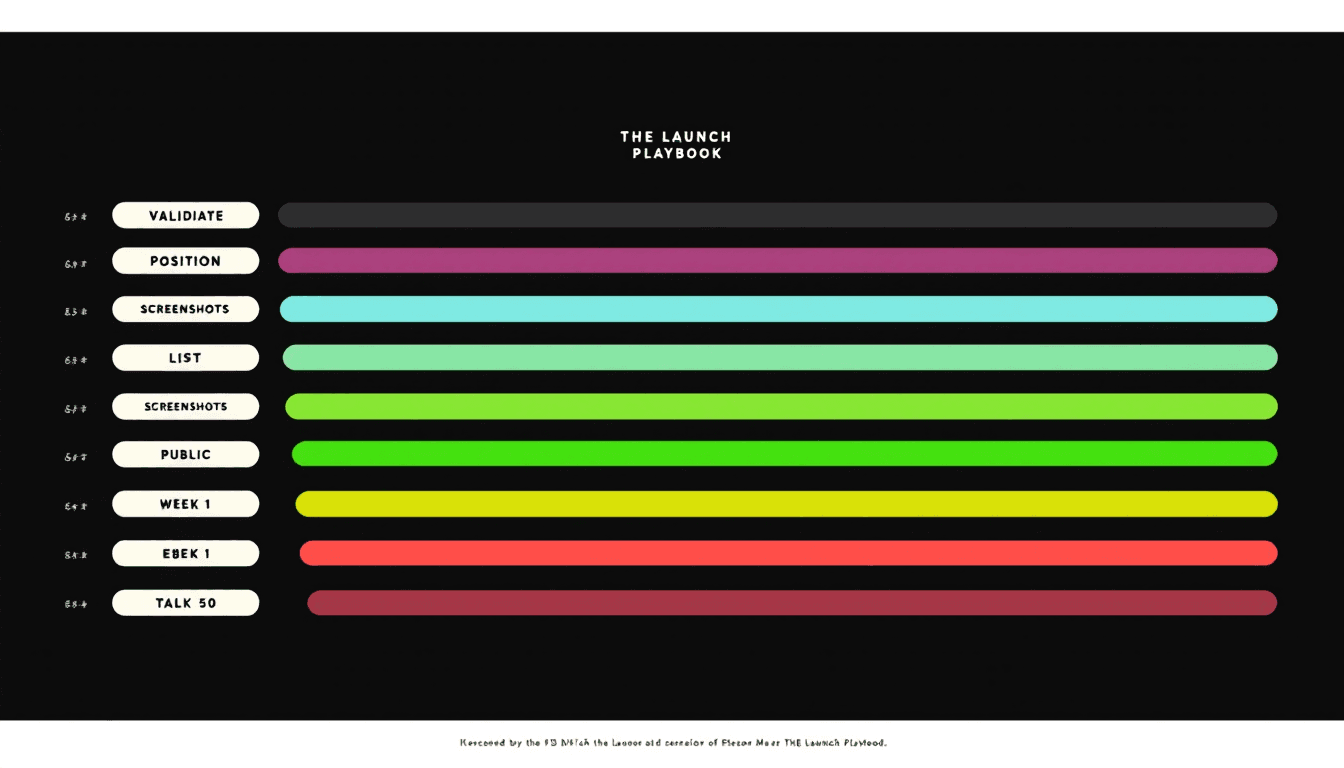
'Build it and they will come' was never said by anyone who shipped on the App Store. The 40-item indie app launch checklist for 2026, organised into eight stages from validation through talk-to-50. Every item is something an indie dev has broken on a real launch.
"Build it and they will come" was never said by anyone who shipped on the App Store.
Indie launches fail in predictable places. Not because indie devs are careless, and not because the App Store is hostile. They fail because the launch is a forty-item checklist disguised as a single Tuesday. The 40 items below are the ones I have either broken myself on a real launch or watched someone else break in front of me.
The list is meant to be printed. Tick by hand. The hand-eye loop catches more than a spreadsheet does. The eight stages map to the eight phases of an indie launch from validation through the talk-to-50.
Why a checklist beats a launch plan
Launch plans are narrative. They sit in a Notion doc and feel thorough at the moment they are written. They do not survive the week of the ship.
Checklists are structural. Forty discrete ticks. Each one either done or not done. The discipline of the checklist is that you cannot rationalise an unchecked box. The narrative of a plan lets you tell yourself that "Apple Search Ads setup" is implicitly handled by "marketing in week three." The checklist forces you to either set up ASA or admit that you have not.
The same discipline applies to validation, positioning, listing fields, and the talk-to-50. Each stage of an indie launch has items that are quietly skipped when there is no checklist forcing the question.
Stage 1. Validate (items 1-5)
The yes-or-no test that decides whether code happens at all.
- You can name the buyer in one sentence.
- You have read 20 one-star reviews of each of the top three competing apps.
- You have written the App Store title before any code.
- You have a one-sentence outcome the buyer would say out loud.
- You have shown the outcome sentence to five strangers in your target audience.
Five items, ninety minutes. If three or more fail to tick, the idea is not validated. Kill it now and save three months.
Stage 2. Position (items 6-9)
Four lines that tell buyers your app is for them.
- Your title carries the anchor keyword in the first five characters.
- Your subtitle uses the second-best keyword plus a four-word benefit.
- Your 100-character keyword field has no repeats with title or subtitle.
- Your category fits buyer search behaviour, not category vanity.
Stage 3. Listing fields (items 10-15)
The actual paste-into-App-Store-Connect work most indie devs do last and should do first.
- Your description leads with the outcome in the first 170 characters.
- Your description does not start with "Welcome to" or "Introducing."
- Your description has a stable "What's new" section.
- Your promotional text is a single benefit, refreshed monthly.
- Your support URL goes to a real support page, not your homepage.
- Your privacy nutrition label is filled honestly. Apple rejects last-minute fixes.
Stage 4. Screenshots (items 16-20)
The 10-rule audit framework compressed into 5 checkpoints.
- First screenshot shows the outcome, not your UI.
- Second screenshot shows the moment of using the app.
- Third screenshot shows social proof, a stat, or a differentiator.
- Every screenshot has a four-word caption above the device frame.
- One portrait set per device class. Skip none.
Stage 5. Soft launch (items 21-25)
Ship to a small market before global. Test the listing under real traffic.
- You have picked a Tier-2 storefront for soft launch.
- You watch the soft-launch conversion rate every day for 7 days.
- You have at least one localised metadata set live.
- You have a TestFlight build with 25 external testers.
- You have run the app on the oldest supported iOS version for ten minutes.
Stage 6. Public launch (items 26-30)
The day of the ship. Boring on purpose.
- Your Product Hunt copy is drafted at least 7 days before launch.
- Your press blurb is one paragraph, 90 words, copy-paste ready.
- Your launch tweet is workshopped on three drafts.
- Your LinkedIn launch post leads with the outcome.
- Your Reddit post lives in r/SideProject or r/IndieDev, not a category sub.
Stage 7. Week-1 ops (items 31-35)
The first 7 days after launch decide whether buyers think you are real.
- You reply to every App Store review in the first 7 days.
- You ship one tiny update in the first 7 days.
- You publish a "what shipped" recap on LinkedIn and X by Day 5.
- You track three numbers daily: impressions, page views, downloads.
- You answer support emails within 24 hours.
Stage 8. Talk-to-50 (items 36-40)
The work that turns a launch into a business.
- You have a calendar link in your welcome email.
- You ask the same 14 questions on every call.
- You record every call with consent.
- You publish one customer story per month.
- You set a calendar reminder for "Cohort 1 retro" at Day 60.
How to use the checklist
Print it. Tick by hand. Two passes per app. The first pass at idea-lock (Stages 1 through 3). The second pass at code-freeze (Stages 4 through 8).
If you tick fewer than 30 of 40 before launch, you are not ready. Delay one week. Tick five more. Then ship. If you have ticked 35 or more, ship anyway. Perfection costs more than the missing five.
The free PDF version is at asogrove.com/tools/app-launch-checklist. Eight pages. A4. Same 40 items, formatted for the wall.
Why we built AsoGrove around this
Most of the work above is process. AsoGrove runs Stages 1 through 4 in one workflow: validation (Stage 1), keyword research and listing fields (Stages 2 and 3), screenshots (Stage 4). Stages 5 through 8 stay on the founder, because soft launch, public launch, week-1 ops, and talk-to-50 are decisions that should not be automated. They should be guided, not delegated.
The companion long-forms cover the deep dives: App Store Keyword Research in 60 Seconds for Stages 2 and 3, and App Store Screenshots That Convert for Stage 4. The validator post handles Stage 1. The full checklist post is the one you are reading.
Forty items. Eight stages. Two passes per app. The boring, structural work that decides whether your app gets seen.
50 founding seats at €49/mo for life are open while Cohort 1 is filling. Claim a founding seat 🌱.